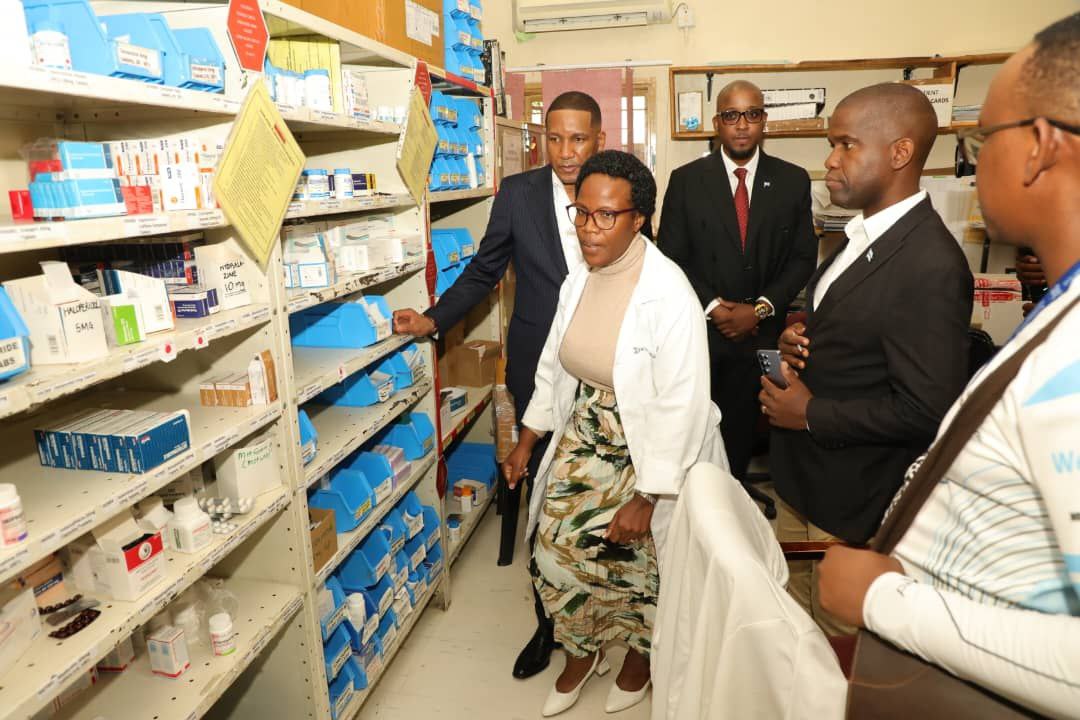
With the citizenry growing increasingly frustrated over the apparent lapses within
the public health sector, marked largely by widespread drug shortages, President
Advocate Duma Boko has affi rmed government’s resolve to turn the sector.
The unfolding crisis in Botswana’s health system, a problem that has, according to
President Advocate Duma Boko,been simmering over decades ought to be halted and stopped from shaking the very soul of the people of Botswana and throwing
them into a state of despondency.
“Th e health questi on is a test for the country, if we cannot solve it, we cannot solve anything else,” he said during his tour of Nyangabgwe Referral Hospital (NRH) last Friday, underlining how unraveling this maze would bear testament to
government’s tenacity to dislodge any challenge that the nation could
find itself faced with at any point in the future.
And making the system whole again will require more than just boldness.
It will take a spirited fight, a fight that government is determined to not back down from.
“That is why we need to take drastic and unorthodox measures to solve it. We need a complete devolution,” President Boko said.
NRH superintendent Dr Ivan Kgetse, who led President Bokothrough various sections and wards of the hospital including the Intensive Care Unit (ICU),
the renal unit, the Accident and Emergency Department, the Radiology Unit and the Antenatal Ward said while the facility wasfaced with a plethora of challenges,
management and staff continue to do their absolute best to serve the
public.
Shortage of drugs, ageing equipment, some of which is already obsolete, as well as
shortage of specialist doctors such as vascular surgeons, radiologists and neurosurgeons daily present themselves as major stumbling blocks to effective service delivery.
According to Dr Kgetse, the lack of critical equipment such as an MRI machine and dialysis machines have compelled NRH to outsource the associated services,
and with the cost of a single MRI scan standing at around P3 000 per scan or test, government forks out untold amounts annually to pay private service providers.
Nyangabgwe hospital also grapples with congesti on, which in some instances is not due to high volumes of patients but is rather because certain spaces are
simply small.
The Neonatal ICU for instance has room for just eight beds, while the main ICU has space sufficient for only six.
“The unit is small as it has only eight beds. As a result, we refer a lot, and the costs are prohibitive,” Dr Kgetse said, in reference to the Neonatal ICU.
As for the main ICU, the doctor would love for the ward to have adequate equipment.
“There is inadequate equipment.For instance, we have got no backup
ventilators, so if one fails, we would not be able to manage the risk,” he explained.
As Nyangabgwe is the only tertiary hospital in the north and so unlike Princess Marina Hospital, which shares its patient load with the couple of private hospitals strewn across Gaborone, its location and the lack of enough private facilities to help ease its load, government should strive to strengthen the hospital so that
it is able to deliver according to
expectation.
Queuing with a loved one at the Accident and Emergency Department, Ms Elizabeth Morebodi of Block 5 in Francistown pleaded with President Boko for
government to avail medicines in health facilities.
“There are no medicines. We are being told to buy for ourselves yet many of us are grappling with unemployment,” she said, echoing the plea of many, who constantly
have to move from one private pharmacy to the next in search of drugs and at times hospitals supplies necessary for surgical procedures to be carried out.
Leave a Reply