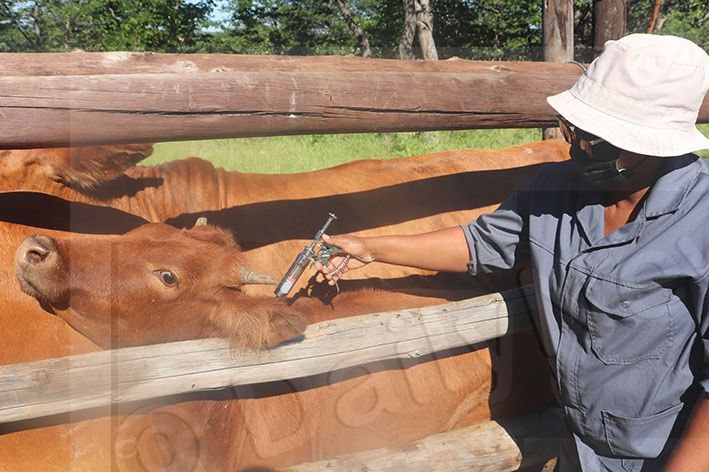
The second phase of Foot and Mouth Disease (FMD) vaccination and surveillance is scheduled to commence on March 4 in zones 3c and 6b, following the successful completion of the initial phase, where all vaccinated cattle will now undergo rigorous clinical inspections.
This was announced by principal veterinary officer at the FMD local command centre, Dr Thito Seomile recently briefing the North East District meeting on the progress of the first phase.
Dr Seomile reported satisfactory herd immunity levels across Zone 6b, North of Bisoli Farm where about 7 400 cattle were vaccinated representing 90.9 per cent coverage and 8 700 or 93.4 per cent in Zone 3c in Maitengwe.
He added that with respect to surveillance, 10 kilometres radius had been done and 1 287 cattle were inspected and was still ongoing as in the 20 kilometres radius a few were left out.
“The only difference there is that the 20km radius in zone 6a there has been an increase in the number of livestock amounting to over 6 700 cattle inspected for any signs of FMD,” he said, adding the rest of zone 6a had not been surveyed due to shortage of resources both staff and vehicle.
He also indicated that inspections extended beyond cattle to including indicator species, such as 450 goats, 10 sheep and pigs in the Jackalas 1 area.
“The clinical inspection was based on the indicator species except for Jackalas 1 where inspection of over 450 goats was done, 10 sheep and pigs,” he said.
Furthermore, he said efforts were being channelled into the FMD blockade to prevent further spread and 70km of fencing had been maintained, with 300km patrolled and 16km of bush clearing completed.
He said a decision had been made to hire 180 casual labourers, 30 from each local village, to prioritise the 3c fence running from Vakaranga, Kgari, Pole, Mosojane, Letsholathebe, Vukwi, Kalakamati to Goshwe.
On one hand, Dr Seomile said six cattle were destroyed after straying into Zimbabwe, with owners receiving P700 compensation per animal while surveillance also showed that there were more Botswana-owned livestock remaining across the border.
He stated that 13 out of 25 villages had formed mephato or community groups, to assist with fence patrols and livestock management, adding they however still needed urgent mobilisation of the remaining communities by leaders.
Also, he indicated that while some regulations hade been relaxed, strict controls remaind in place to protect the industry and animal products may move from Francistown into zones 3c and 6b, but the reverse was strictly prohibited.
Dr Seomile also said although meat movement had been relaxed, bush slaughter remained illegal and all slaughter must occur at authorised abattoirs in zones 4a, 4b, 5, 8, 9, 10, 11, 12 and 13.
He also said a committee had been activated to inspect butcheries in North East and Francistown to ensure meat originated from approved zones.
He said inspections of the Tati ranches near Francistown ranches, revealed many ranch fences were in a dilapidated state, thus owners were urged to urgently repair them.
To sustain daily operations and complete the surveillance of Zone 6a, Dr Seomile emphasised the need for additional heavy equipment, including 4×4 vehicles, six dozers, six caterpillars and four Tractor-Loader-Backhoes (TLBs).
Second Phase of FMD Vaccinations Starts
Leave a Reply