President AdvoPresident Advocate Duma Boko says collective strategies are needed from Batswana in order to revive the country’s economy.
Speaking at this year’s International Workers Day commemoration in Letlhakane on May 1, President Boko said it was crucial for all to play a role in the resuscitation of the country’s economy.
For a long time, he said Botswana’s economy relied on diamonds as its main revenue earner, hence the current economic state of affairs.
“We now have an undiversified mono-sectoral economy, heavily dependent on diamonds,” he said.
This, he said called for intensified strategies of diversifying a sustainable economy for better workers’ salaries, schools and health facilities among other developments and also to prevent the occurrence of retrenchments.
To grow the economy, the President said there was need for the country to venture into manufacturing, adding that this would also mean creation of employment.
The President also talked about the recently commenced Maun 500MW Solar Photovoltaic Plant, adding that upon completion and operational, Botswana would import less power from South Africa, which would in turn save government funds.
He said every year, Botswana spent P3 billion on the importation of power.
Nonetheless, he acknowledged low salaries for public service employees and had assured them that they would be a happy cohort by December.
Botswana Federation of Trade Unions president, Ms Martha Molema pleaded with government to consider a better increment for workers, saying their wages had been stagnant for a long time, while prices for commodities were soaring.
For his part, Botswana Federation of Public, Private and Parastatal Sector Unions, Mr Gotlamang Oitsile implored government to work with unions in a bid to take the economy of Botswana to greater heights.
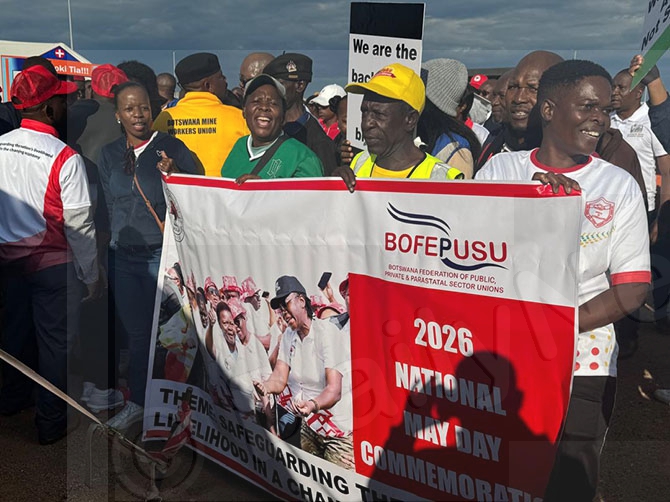
This year’s International Workers Day was commemorated under the theme: Safeguarding the Nation’s Livelihood in a Changing Economy, highlighting growing national dialogue around job security, workers protections and economic adaptation amid shifting global and domestic markets. BOPAcate Duma Boko says collective strategies are needed from Batswana in order to revive the country’s economy.
Speaking at this year’s International Workers Day commemoration in Letlhakane on May 1, President Boko said it was crucial for all to play a role in the resuscitation of the country’s economy.
For a long time, he said Botswana’s economy relied on diamonds as its main revenue earner, hence the current economic state of affairs.
“We now have an undiversified mono-sectoral economy, heavily dependent on diamonds,” he said.
This, he said called for intensified strategies of diversifying a sustainable economy for better workers’ salaries, schools and health facilities among other developments and also to prevent the occurrence of retrenchments.
To grow the economy, the President said there was need for the country to venture into manufacturing, adding that this would also mean creation of employment.
The President also talked about the recently commenced Maun 500MW Solar Photovoltaic Plant, adding that upon completion and operational, Botswana would import less power from South Africa, which would in turn save government funds.
He said every year, Botswana spent P3 billion on the importation of power.
Nonetheless, he acknowledged low salaries for public service employees and had assured them that they would be a happy cohort by December.
Botswana Federation of Trade Unions president, Ms Martha Molema pleaded with government to consider a better increment for workers, saying their wages had been stagnant for a long time, while prices for commodities were soaring.
For his part, Botswana Federation of Public, Private and Parastatal Sector Unions, Mr Gotlamang Oitsile implored government to work with unions in a bid to take the economy of Botswana to greater heights.
This year’s International Workers Day was commemorated under the theme: Safeguarding the Nation’s Livelihood in a Changing Economy, highlighting growing national dialogue around job security, workers protections and economic adaptation amid shifting global and domestic markets. BOPA
Leave a Reply