Category: Daily News

  • BPS and BDF Aim for Safer Festive Season

    BPS and BDF Aim for Safer Festive Season

    The second phase of Operation Pabalesego, a joint security initiative led by the Botswana Police Service (BPS) and the Botswana Defence Force (BDF), aimed at strengthening public safety and combating rising crime in communities was launched on Friday.

    The operation, rolled out in Mogoditshane, follows the inaugural phase held last year in Gaborone West. It brings together multiple law enforcement agencies in coordinated patrols, intelligence operations and community engagement activities to enhance national security.

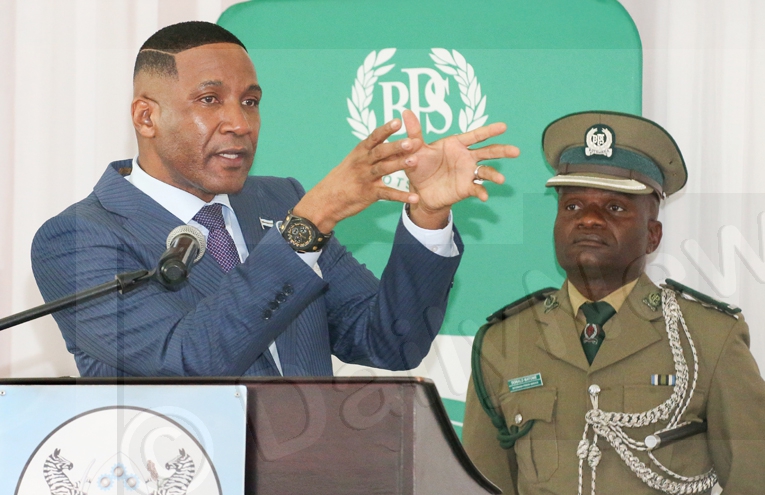
    Launching the operation, President Advocate Duma Boko commended members of the security services for their continued dedication under increasingly demanding conditions. “Your commitment is central to maintaining safety and order across Botswana,” he said.

    He urged Batswana to support law enforcement efforts and take responsibility for the safety of their families and neighbourhoods. President Boko also condemned the growing cases of gender-based violence (GBV), describing the scourge as a serious threat to families and community cohesion.

    “I appeal to the public to promote respect, empathy and non-violence in all relationships, particularly romantic ones,” he said.

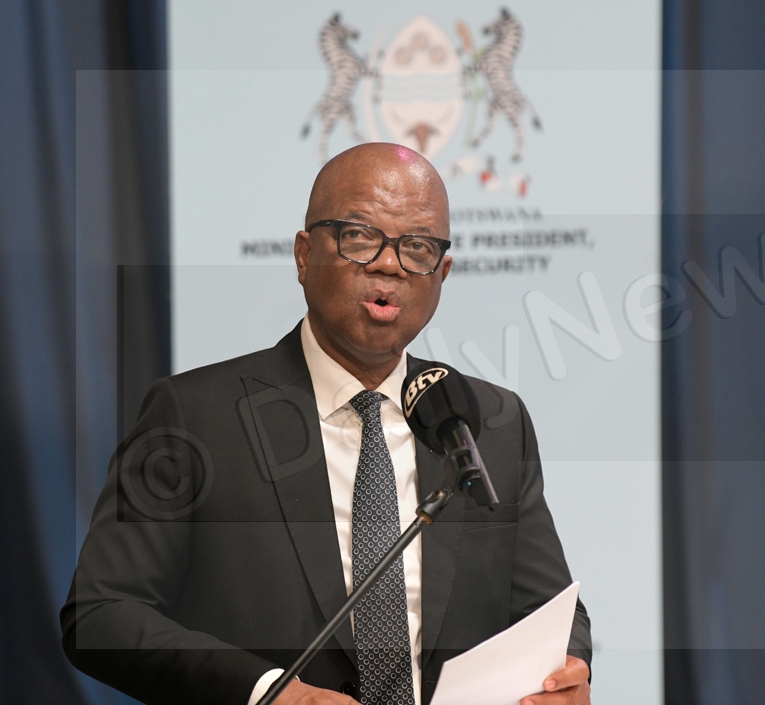
    Police Commissioner, Ms Dinah Marathe said Operation Pabalesego II sought to reduce serious and violent crime by increasing police visibility, intensifying intelligence-led patrols and improving collaboration between security agencies. She explained that the operation focused on hotspots known for robberies, break-ins, domestic violence reports, drug abuse and traffic violations.

    Commissioner Marathe noted that the first phase of the operation yielded positive results, with a 17 per cent reduction in armed robberies and a 12 per cent decline in burglary cases in Gaborone West over a three-month period. She said the police were confident that similar or better outcomes could be achieved in Mogoditshane and the surrounding areas, particularly as the festive season approached.

    She said Operation Pabalesego II also aimed to dismantle criminal networks and strengthen community-police partnerships, by engaging residents, neighbourhood watch groups and local leadership.

     “Our goal is not only to arrest offenders but to restore public confidence and create safer spaces where people can live, work and move freely,” she said.

    Commissioner Marathe further highlighted GBV, drug trafficking and youth delinquency as areas of concern. She revealed that BPS recorded over 6,500 GBV-related cases nationwide between January and September this year, with emotional abuse, assault and defilement ranking among the most reported.

     “These numbers are alarming and we are intensifying our efforts to ensure protection for victims while holding perpetrators accountable,” she said.

    Minister for State President, Mr Moeti Mhwasa thanked President Boko for prioritising public safety, noting that the operation reinforced government’s commitment to preserving peace and order.

    Also addressing the event, Youth of Hope Safe Haven founding chairperson, Mr Boyson Mokone cautioned young people against drug abuse, warning that substance dependency continued to tear families apart. He urged men to take responsibility for nurturing the boy child saying neglect often drove young boys into destructive behaviour.

    “Men should know they either destroy or build the boy child,” he said, adding that recovery from drug addiction was possible with support and commitment.

    Operation Pabalesego II is expected to run throughout the festive season, a period historically associated with spikes in crime and social disorder.  The operation will combine high-visibility patrols, stop-and-search exercises and intelligence-led interventions to ensure safer communities countrywide.

  • Botswana Ready to Learn from Lesotho

    Botswana Ready to Learn from Lesotho

    President Advocate Duma Boko says as Botswana ventures into cannabis production, a leaf can be taken out of Lesotho experience as it is advanced in the area of cannabis production and its export routes.

    “Lesotho is effectively a leader and pioneer in that field with full value chain beneficiation of the product and positioning for exports while Botswana cannabis production is still at an infant stage. We are therefore, looking forward to collaborate and learn from Lesotho,” said President Boko during a courtesy call by Lesotho Prime Minister, Mr Samuel Matekane at the Office of the President on  Friday.

    President Boko said it was pleasing to note that the bilateral relations between the two countries dated back to the colonial era and were rooted in strong historical ties hence it was not surprising for the two countries to be working on a water project which was on the final feasibility study stage.

    Upon completion, the project would benefit the country’s water supply particularly the Southern part as well as enable construction of the proposed five megawatt hydropower station which would be a great addition to the country’s power generation.

    President Boko said Botswana looked forward with keen interest toward the implementation of the project, thus expressed optimism that Lesotho would be a good partner for its success. 

    “ I strongly believe that we have a good partner in Lesotho, as it has pulled off one of the biggest engineering projects in the design of its dams and we are grateful to have them on board in this water project,” he said.

    He stated that both countries would explore other future areas of cooperation owing to the many affinities and opportunities of collaboration. Additionally, President Boko commended Lesotho for the success in the fight against drugs and substance abuse.

    “One of the areas that Lesotho has been successful on, is the ability to retrieve young people from the streets who were victims of drug addiction. The boot camp has rescued many and gave them a new lease of life therefore, we also look forward to collaborate on such projects,” he said.

    In reference to bilateral relations, President Boko stated that Botswana and Lesotho long established diplomatic relations, way before the so called definition of the nation’s states post-independence. He highlighted that the relations between the two nations were deeply rooted in the cultural similarities.

     Prime Minister Matekane, on the other hand said the existing bilateral relations between Lesotho and Botswana provided an enabling environment for investors from across both countries to widen their business ventures and further enhance economic relations.

    “There is no doubt that the private sector is the engine of growth for both countries respective economies to prosper and it is on the backdrop of such that the relations between the two have created an enabling environment for private sector led cross border investments to thrive,” he said.

    Mr Matekane said there were various sectors the business communities between the countries could collaborate on, such as the Lesotho citrus fruits industry. He reaffirmed Lesotho’s commitment to continue engaging with Botswana on developmental issues that affected economic cooperation between the two countries.

    “We sincerely appreciate the opportunity granted to us to explore the beef industry and how to master it,” he said.

    Mr Matekane highlighted the need to increase economic cooperation through promotion of trade relations that could benefit both nation’s citizenries.

    “Lesotho already produces quality car leather seats for various models while Botswana on the other hand have plenty of cow leather, therefore the leather can be exported to Lesotho for mutual economic benefit,” he said.

    Equally, he said Botswana possessed plenty of beef while Lesotho had mutton which presented trade opportunity in that aspect. Mr Matekane therefore, asked for the establishment of regular cultural exchange forum and food exhibitions between the two nations. 

  • Children Day Symbolizes Renewed Commitment

    Children Day Symbolizes Renewed Commitment

    President Advocate Duma Boko on Saturday, hosted a special luncheon bringing together children from across the Southern African Development Community (SADC), marking a significant moment in the region’s ongoing commitment to child rights, participation and empowerment.

    The event followed a morning of youth-focused activities and dialogues centred on strengthening regional cooperation to uplift and protect children. Ministry for International Relations head of consular services, Ms Tebatso Baleseng said that the gathering served as a reminder to regional leaders to place children at the centre of all decision-making processes.

    Ms Baleseng underscored the centrality of the United Nations Convention on the Rights of the Child (UNCRC) in guiding policy across the region, adding that children must be promoted, protected and respected within each of the Southern African countries and collectively across the region.

    She said that the luncheon was not simply a ceremonial gathering but a reaffirmation of the region’s responsibility to view children not just as beneficiaries of protection, but as rights holders with the agency to influence future development.

    The presence of children and youth at the event symbolises a renewed commitment to creating platforms where young people could articulate their aspirations and concerns. Ms Baleseng therefore, urged leaders across the region to open avenues for meaningful dialogue with children, ensuring that youth perspectives guided the policies and decisions that affected them.

    The luncheon formed part of ongoing regional efforts to strengthen child-centric governance, promote youth engagement and build a future where young voices were recognised as essential to shaping Southern Africa’s development agenda.

    In attendance to the lunch were regional leaders across SADC, senior government officials and members of the diplomatic community, underscoring the spirit of cooperation and shared development priorities across Southern Africa.

  • First Lady Calls For Policy Implementation

    First Lady Calls For Policy Implementation

    Children have a right to information concerning developments and should be listened to, so that they can enjoy all their rights without fear.

    When things are not done right, they should hold the government accountable so that it delivers on its promises. First Lady Ms Kaone Boko said during the Regional World Children’s Day dinner on Friday in Gaborone. She said government was committed to providing timely reports on the progress made.

    Ms Boko called on ministries responsible for children’s welfare to turn promises into actions, stressing the need for implementation and policy changes to align with this year’s World Children’s Day theme: My Day, My Rights. From Promise to Action. Restructuring of the Ministry of Education to include child welfare was a positive development, and now it is time for it to deliver on its promises, Ms Boko said. 

    Ms Boko highlighted the significance of unity, noting that children learnt from harmonious relationships., making reference to her good rapport with the two former first ladies, Ms Barbra Mogae and Ms Neo Masisi, as well as the Leader of the Opposition’s wife, Ms Dineo Saleshando, who were all present to support a common cause despite belonging to different political parties.

    Upon assuming the role of First Lady, Ms Boko said she introduced herself to Ms Mogae, who welcomed her warmly and shared words of wisdom, while Ms Masisi offered valuable pointers. She also mentioned that Ms Saleshando had always been her pillar of strength.

    Minister of Child Welfare and Basic Education, Ms Nono Kgafela-Mokoka acknowledged that a lot still needed to be done, and called for strengthened collective efforts among stakeholders, to foster a conducive environment for children. Caring for, protecting, and empowering children is a shared responsibility worldwide, Ms Kgafela- Mokoka said.

    The Private Sector Forum for Child Rights’ Ms Joy Buno, for her part highlighted the importance of introducing financial literacy into the school curriculum, a development that required no additional funds but policy amendments.

    This she said could be made possible with help from businesses, to uplift and empower children. The event was attended by children from Botswana, Lesotho, South Africa, Zimbabwe, Mozambique, Malawi, eSwatini, Zambia, and Namibia, in celebration of World Children’s Day. 

  • KGK Commit to Youth Development

    KGK Commit to Youth Development

    KGK Academy, the training arm of KGK Diamonds Group Botswana, one of the country’s largest cutting and polishing operations has produced its 2025 cohort of 88 graduates, marking another milestone in Botswana’s drive to build local capacity in the diamond value chain.

    The graduates completed a 12-month programme comprising six months of theory and six months of practical assessments, including an attachment within the organisation. Their completion has paved the way for 40 new trainees who are continuing with the Academy.

    Delivering the keynote address, Minister of Minerals and Energy, Ms Bogolo Kenewendo, praised KGK Diamonds for its commitment to youth skills development and for integrating trained graduates into the labour market. She further commended the company for its sustained contribution to Botswana’s diamond cutting industry, where it employs over 25 percent of the national workforce in the subsector.

    “KGK has given beyond diamonds. It is the only company in the industry that has opened a day-care centre within its premises, enabling young mothers to bring their children to work,” Ms Kenewendo said, describing the initiative as a powerful example of inclusivity.

    She also highlighted the company’s solar-powered factory, noting that it sets a strong foundation for the growth of a local jewellery manufacturing industry and contributes significantly to socioeconomic development. She affirmed her ministry’s support for initiatives that further local beneficiation.

  • Angola and Botswana Forge Relations Within SADC and AU

    Angola and Botswana Forge Relations Within SADC and AU

    Botswana and Angola have forged partnership in African solidarity and strengthened through many years of cooperation within the frameworks of SADC and the African Union, says Permanent Secretary in the Ministry of International Relations Mr Thuso Ramodimoosi.

    Mr Ramodimoosi said this at the commemoration of Angola’s 50th anniversary of independence. He said the partnership is sustained by a shared commitment to the development and advancement of each other’s peoples.

    Botswana and Angola collaborate across a wide range of sectors, including water resources, conservation, agriculture, transport, mining, and energy, as well as in the promotion of peace and security in the region.

    Mr Ramodimoosi reaffirmed the commitment of the government of Botswana to strengthening the bonds of friendship and bilateral cooperation with Angola. He said the two countries are leading diamond-producing countries, and they were deepening their partnership and collaboration in the diamond mining sector.

    Additionally, he said the two countries, together with the Democratic Republic of Congo, Namibia, and South Africa, signed the Luanda Accord, which is a landmark agreement in the promotion of natural diamonds.

    Meanwhile, Ambassador of Angola to Botswana Ms Beatriz Morais said Angola has prioritised strengthening cooperation in areas of politics and diplomacy, oil and petroleum products, energy and water, agriculture and livestock, as well as telecommunications, diamonds and other minerals, tourism, and the environment, particularly biodiversity conservation.

    “In addition to bilateral issues, Angola and Botswana have multilateral relations at the SADC level, including the Kavango-Zambezi Transfrontier Conservation Area (KAZA TFCA), the Zambezi River Basin Commission (ZAMCOM) and the Permanent Okavango River Basin Water Commission (OKACOM), with the aim of strengthening regional integration,” said Ms. Morais.

    She acknowledged and recognized the role and contribution played by other African governments for the national liberation struggle of Angola, for the country’s peace to be a reality, and for reconstruction and development to take place to this day. 

    “This is a gesture of recognition and acknowledgment to these peoples and countries, including Botswana, for their invaluable support for the Angolan people at different times in our history,” she said.

    Ms Morais further said the 50-year milestone of Angola’s independence urges them as a country to look back at the road they travelled toward building a developed and prosperous Angola: from resistance to colonial oppression and the emergence of Angolan nationalism, from the national liberation struggle to the conquest of national independence, from armed conflict among children of the same land to the embrace of reconciliation, and from the destruction wrought by war to national reconstruction. 

    She said the milestone is also a sublime moment to reflect on the future they are building with the contribution of all Angolans.

  • China Trip Strengthened Strategic Cooperations – Motlaleng

    China Trip Strengthened Strategic Cooperations – Motlaleng

    The Gaborone City Council’s recent trip to China is a transformative step toward strengthening urban development, investment cooperation and people-to-people relations between Botswana and China.

    During a dialogue with China Ambassador to Botswana on Friday, Gaborone city mayor, Mr Oarabile Motlaleng revealed that one of the most promising trip outcomes was China’s willingness to support Botswana in establishing stronger human-resource structures, an area which had not previously been recognised as a standalone committee within national development frameworks.

    “We wanted to empower our communities and when we raised the idea of creating a Human Resources Committee, the Chinese Embassy agreed with us, that gave us great joy,” he said.

    Mr Motlaleng said the visit also opened opportunities for investment partnerships, especially those linking local committees with potential Chinese investors.

    He acknowledged China’s longstanding contributions to Botswana’s economic development, citing Chinese-owned businesses such as those at Oriental Plaza and major infrastructure developments, including the new skyscrapers rising across the country.

    Mr Motlaleng said the delegation also visited the city of Linyi, renowned for its advanced environmental and vegetation-management systems, adding that the practices offered valuable insights for Gaborone’s urban-planning initiatives, as Botswana was preparing for the development of a new ‘Diamond City.

    He further said another highlight was progress on solar-powered infrastructure, announcing plans to install between 30 000 and 40 000 solar-powered streetlights across Gaborone by next year. 

    Schools, roads and public spaces, he said would benefit from the renewable-energy initiative.

    Mr Motlaleng further revealed that relations formed during the visit had already borne fruit, with a delegation from Linyi arriving in Botswana to explore business opportunities. 

    Areas of potential collaboration include investment, sport, maintenance and improvements to the athletics village and city lighting.

    For his part, China Ambassador to Botswana, Mr Fan Yong, reaffirmed China’s commitment to strengthening development cooperation, deepening people-to-people exchanges and supporting Botswana’s national development plans.

    He described the councillors’ visit as ‘very fruitful’, noting that it had laid a solid foundation for expanded collaboration.

    Ambassador Fan said China was advancing toward its second centenary goal of becoming a ‘great modern socialist country in all respects’.

    A key component of this vision, he explained, was the newly adopted recommendations guiding China’s 15th Five-Year Plan, which emphasised high-level opening-up and global cooperation.

    He highlighted local-government partnerships as critical pillars of the bilateral relationship. 

    Gaborone’s sister-city agreement with Nantong in Jiangsu Province, established in 2008, continues to facilitate cultural and developmental exchanges. 

    Another MoU with China’s Fujian Province was signed in 2023. During the council’s latest visit, Gaborone also deepened its partnership with Linyi in Shandong Province.

    “These interactions will surely enhance mutual understanding between our peoples and inject fresh impetus into our practical cooperation,” he said.

    Meanwhile, Mr Fan said Botswana’s ongoing formulation of the 12th National Development Plan and implementation of the Botswana Economic Transformation Programme presented new opportunities for alignment with China’s 15th Five-Year Plan.

    He identified key areas of strategic synergy, including high-quality development and industrial transformation where China’s focus on new energy, new materials, aerospace and next-generation technologies complements Botswana’s economic-diversification goals.

    He also discussed China’s commitment to high-standard opening-up, which aligns with Botswana’s trade and investment aspirations. Frameworks such as FOCAC, the Belt and Road Initiative and the Global Development Initiative which offer platforms for further collaboration, he noted.

    Sharing experiences from the visit, Phakalane Ward councillor, Mr Kaisara Sejoe praised China’s advanced security systems, noting their high effectiveness in detecting crime.  

    He expressed appreciation for the Chinese Embassy’s support in sponsoring capacity-building initiatives, saying the training and exposure gained in China would significantly enhance their work and the city’s overall development.

  • Speakers Eulogise Mpuse

    Speakers Eulogise Mpuse

    The Department of Information Services photographer, Godfrey Mpuse has been described as a man of many admirable qualities, unifier, family man and a dependable source of wisdom.

    Speaking at Mpuse’s funeral service in Thamaga on Saturday, former president, Dr Mokgweetsi Masisi described Mpuse as an individual of exceptional character, whose contribution to the nation deserved honour and recognition.

    He said it was befitting to have such a gathering when bidding farewell to a unifier.

    Dr Masisi noted that Mpuse’s special duty as a presidential photographer required precision and artistic vision, which he executed with precision.

    “He even took my last photo in office,” Dr Masisi recalled, adding that he had an eye for detail.

    He explained that working as a presidential photographer demanded a unique artistic ability, discipline and commitment.

    He thanked Mpuse’s wife, Nametso and his parents for giving the nation a true servant. 

    Addressing aspiring photojournalists, Dr Masisi encouraged them to emulate Mpuse’s dedication and hunger for quality, adding that learning from him would guide them to produce excellent work.

    Dr Masisi emphasised that photographers played a crucial role in preserving national history, not only through words and writing, but visually. 

    Acting Director of the Department of Information Services, Mr Thebeyame Ramoroka said Mpuse joined the public service in 2007 and quickly proved himself as one of Botswana’s most reputable photographers.

    He praised Mpuse for delivering world-class photographs that communicated a thousand words, noting that his work ethic often pushed him to go beyond protocol to capture exceptional images.

    Mr Ramoroka added that Mpuse was part of a trusted group assigned to high-profile national duties involving elders, where decorum was essential.

    “He never faltered in his assignments. His behaviour and dress code were exemplary,” he said.

    He highlighted Mpuse’s respectful frankness, saying he spoke his mind with humility.

    His passing, he said, dealt a major blow to the department.

    Mpuse’s uncle, Mr Bathusi Moarabi, shared that the deceased had recently informed the family of his health challenges, yet remained active in family responsibilities.

    Mr Moarabi said Mpuse’s final days included attending a meeting for a family wedding in Hebron.

    On his way back, he said he felt sick and had beathing difficulties and was taken to Kanye Adventist Hospital, where he later passed on. 

    “We have lost as a community, but we are comforted by the life he lived and the impact he made,” he said.

    Family representative, Mr Shimane Dikobe said Mpuse was ‘more than a son-in-law’, describing him as loving, supportive and fatherly to many. 

    Friend and caregiver, Mr Thato Mosinyi, who described Mpuse as loyal, courageous and resilient, thanked God for the privilege of walking with him through his final journey.

    He recalled attending an assignment at the Office of the President with Mpuse, where he complained of chest pains and breathing difficulties but still displayed his persistent spirit.

    Mpuse’s niece, Ms Bonno Mpuse, described him as a unifier who related well with everyone.

    Member of Parliament for Thamaga-Kumakwane, Mr Palelo Motaosane said Mpuse’s ability to work with the former president showed his exceptional skill and discipline.

    He urged Mpuse’s wife to stay strong and grounded as she continued raising their children. 

  • Nyangabgwe Hospital Unveils Paediatric Theatre

    Nyangabgwe Hospital Unveils Paediatric Theatre

    Nyangabgwe Referral Hospital has unveiled the renovated paediatric theatre, made possible through donation by KIDS Operating Room, a United States America-based non-profit organisation. The state-of-the-art facility is the first dedicated paediatric surgical theatre at the hospital, designed exclusively to meet the surgical needs of children. 

    The theatre becomes the second of its kind in Botswana, following the installation of a similar facility at Princess Marina Hospital in Gaborone.

    It is equipped with modern, high-tech surgical equipment, thanks to the philanthropy of Mr Steve Lansdown and wife, Maggie, who are based in the United Kingdom.

    Head of the Project, Mr Caleb Machaira, described the donation as a step toward improving healthcare delivery, ensuring that children received specialised care they deserved. 

    Mr Machaira stressed the importance of access to safe surgical care for children, noting that the new theatre would allow young patients to receive specialised treatment closer to home, ultimately transforming countless lives. 

    For his part, Mr Lansdown said the organisation had been approached for assistance during the COVID-19 pandemic, a time when Botswana faced numerous challenges. 

    Nyangabgwe Hospital Superintendent, Dr Ivan Kgetse expressed gratitude to the donors, acknowledging that government alone could not meet all healthcare needs. 

    He commended the donors for their role in saving the lives of children. Delivering a vote of thanks, nominated councillor and Francistown City Council Health Committee chairperson, Mr Amos Madeluka, said the facility would serve not only children in Francistown but those across the entire country.

  • Leadership Acts Against Illegal Sand Mining

    Leadership Acts Against Illegal Sand Mining

    North West district is blessed with natural resources, fertile soils and water bodies and yet the resources are under increasing pressure from pollution, deforestation illegal sand mining, among others.

    Illegal sand mining from the water bodies particularly rivers compromise the aquatic system, something, which the district leadership is fighting tooth and nail to nub in the bud.

    Recently, the district leadership, law enforcement agencies and other local authorities embarked on an operation led by the district commissioner to assess damages caused by illegal sand mining along the Shashe water channel that forms part of the Thamalakane River.

    The district commissioner, Mr Thabang Waloka revealed in an interview that the operation was prompted by the public outcry over the growing incidents of illegal sand mining along the Thamalakane river and other water bodies in the district. He expressed a serious concern that the practice had destroyed the environment and the river altering its natural flow due to deep open pits or trenches that created environmental problems.

    Illegal miners, he said had turned the river into a quarry looking at the amount of sand extracted along the river channel starting at Boro area, adding that it seemed perpetrators had ventured into a lucrative business of selling sand.

    “We are overwhelmed by reports of illegal sand mining activities in our district, hence we have reignited the fight against the practice due to its severe environmental degradation, economic impact and safety risks. As leadership in collaboration with law enforcement committee we will not give up against environmental degradation,” he added.

    Mr Waloka also warned members of the public to refrain from buying illegally mined sand as that exacerbate the criminal activity, saying they should buy from licensed companies.

    In the district, he said there were about five licensed companies. 

    He also appealed to members of the community to join forces with the law enforcement committee to stop illegal activities and deter perpetrators. 

    Residents were urged to report any suspicious activities related to illegal mining to local authorities.

    Councillor for Thito/Bombadi area, Mr Lerayamang Baswi also expressed worry over illegal sand mining, saying over the years, they had observed harvesting of sand from rivers which had a negative impact on the environment.

    Efforts by residents to deter perpetrators, he said were in vain as the practice still persisted, which also presented a hazard for members of the community including livestock.

    “The pits are very deep and very dangerous as some people and animals can fall into especially during rainy season. Recently, one of the farmers reported that one of his cattle had fallen into one of the pits,” he added.

    Councillor for Shashe/Botshabelo ward, Mr Keakgotswe Bokhutlo stated that illegal sand mining was rife in the area placing an enormous pressure on the environment.

    He appreciated efforts by local authorities for conducting the operation saying that was testament that they were equally concerned with the practice. 

    “The fight against illegal mining must be seen as a shared national responsibility and it is commendable to see leaders acting collectively towards the course,” he added.