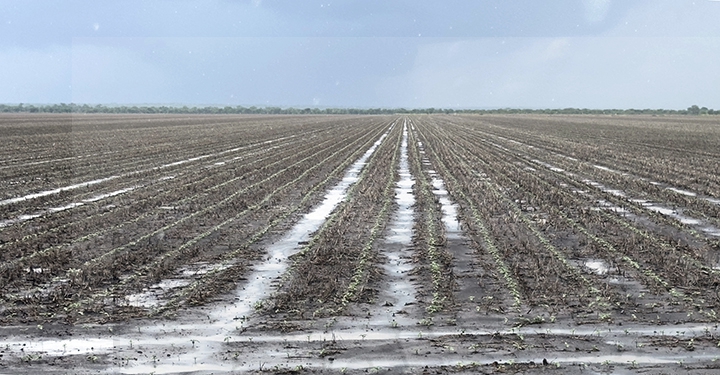
Following the recent heavy downpours in Pandamatenga that left farms submerged in water, the path to recovery for Botswana’s food basket hinges on water to recede and soil moisture to reach a workable consistency.
The one-in-200- years’ storm on January 21 which dropped over 150mm of rain submerged over 8,000 hectares of crops from sorghum, sunflower, maize, onion, tomatoes, beans.
Pandamatenga remains critical to national food security contributing 47 per cent to Botswana’s national crop production mostly sorghum, millet, beans, wheat, chickpeas supported by the 90,000 metric tonnes grain storage silos hosted in Pandamatenga.
Department of Crop Production- agronomist for Pandamatenga Commercial Farmers, Ms Emeliah Magosi told BOPA that there was hope for Botswana’s food basket, as the window for replanting remained open to February and March for Pandamatenga.
However she said replanting would be enabled by a shift from heavy rains to scattered showers and warmer temperatures for the cotton soils to hold just adequate moisture.
Farmers might be compelled to change cropping plans, to suit the high soil moisture and ideally plant wheat, chickpeas, sunflower and mung- beans, Ms Magosi said.
She explained that it was premature to analyse the damages suffered by the 8,000 hectares planted crops as mostly were still submerged in water. This translates to a variation of risks from nutrients loss, stunted growth, and rotting.
Hope remains for farmers to return to full operations and optimise on their equipment because they have sufficient farming implements to accelerate production.
With Pandamatenga being a floods prone area, Ms Magosi said government installed drainage and roads infrastructure within the commercial farms to address such occurrences.
“The purpose of the drainage system in the farming area was to address unfavourable conditions such as floods and its only that the recent rains were a rare occurrence and without the trenches it could have been a calamity,” she said.
Consequent to heavy rains, Ms Magosi said risked to be expected include pests outbreak, mostly quelea birds and army worms. High humidity also poses a risk of fungus which demands a lot of output from farmers to spray their crops.
Recapping on last season’s performance, Ms Magosi remarked that a total of 27,247 hectares of sorghum was planted by commercial farmers producing 81,369 tonnes.
She said a total of 5 568 hectares of cowpeas was planted producing 4,338 tonnes while 2,032 hectares of beans was planted and 1,902 tonnes harvested.
Author: Daily News
-
Hope Remains for Pandamatenga Farmers Recovery
-

Raguin Impressive Australian Open Juniors Run Ends
Ntungamili Raguin’s impressive run at the Australian Open Junior Championships 2026 has come to an end after suffering a 6-4, 6-3 defeat against world number three, Luis Augusto Queiroz Miguel of Brazil in the last 16 on Thursday.
The 17-year-old has made the country proud as the first Motswana to compete at a junior Grand Slam, delivering strong performances from the qualification stage through to the main draw and into the last 16.
His achievement is commendable, considering that he was still battling to secure a place in the Australian Open qualifying draw just a month ago.
Throughout the tournament, Raguin demonstrated maturity, composure and the ability to perform under pressure, qualities that have set him apart from many of his peers.
However, Queiroz Miguel, who recently won the J300 tournament in Traralgon and was seeded second at the Australian Open juniors competition, proved a tough nut for Raguin to crack.
Despite the loss, Ntungamili will take some positives from his exploits at the Australian Open juniors having made it all the way to the last 16. In the first round, he edged out Bulgaria’s Dimitar Kisimov 7-5, 1-6, 6-4.
In the second round, he continued his good form, reaching the last 16 after beating tournament 15th seed Gavin Goode of the United States. He won the first set 6-2, lost the second 3-6, and came back strongly to claim the deciding set 6-4.
With the Australian Open juniors behind him now, Raguin will next compete in the J300 tournament in Ecuador on clay courts, followed by preparations for the French Open Junior Championships 2026.
Botswana Tennis Association president Oaitse Thipe has expressed delight at the player’s performance, especially the positive results he achieved against stronger opponents.
Thipe said they were expecting Raguin to learn from the experience and apply the lessons in his upcoming competitions.
“He should hold his head high and now focus on preparing for the French Junior Open. He fought hard and his Australian Open run was good,” he said.
Raguin is currently ranked 75th, and his performance is expected to improve his ranking, as reaching the round of 16 earned him 180 points. -

I Too Thought I Was Out Advocates for Mental Health
In an effort to advocate for mental health awareness, Tumo Sehube, a native of Nata, has made a significant mark as a French teacher, mother, entrepreneur, and self-made mental health advocate with her new book titled : I Too Thought I Was Out.
“Writing this book was a way of speaking for those who cannot, for myself, and mostly for my father who has been mentally challenged since I was three years old,” she shared.
The process of writing was challenging, as she faced her past experiences while striving to present a narrative that would honour her journey without casting blame on those she has encountered in life.
Despite these hurdles, Sehube successfully wrote a book that resonates with a wide audience, offering relatability, healing and guidance for readers navigating their own struggles.
In addition to her writing, Sehube runs an online boutique and works as a real estate agent. She reflected on the impact of her father’s mental health status, which once brought her feelings of hopelessness.
“I thought it was the end of a sane me. But somehow I made it, and that is why I have shared my story to save others out there,” she said.
Sehube emphasizes that no one is immune to mental health challenges, explaining that the brain, like any other part of the body, can sustain injury or malfunction. This makes awareness and understanding of mental health issues crucial.
Her inspiration to write I Too Thought I Was Out stemmed from attending Ndiko Muzila’s book launch, where a speaker highlighted the profound impact literature can have in reaching unseen audiences.
“I have always had this impression that God has sent me to the people, and then I knew writing a book would be perfect because I am naturally not good in regular interactions,” Sehube stated.
Drawing influence from the writings of Maya Angelou, Sehube hopes her book will continue to inspire and empower others in their mental health journey.
-
Malak Move Great Opportunity
The recent move by Malak Macheng to the African Regional Training Centre (ARTC) in Tunisia has been hailed as a milestone achievement by the Botswana Tennis Association (BTA).
The 13-year-old ace, who won back-to-back International Tennis Federation (ITF)/ Confederation of African Tennis (CAT) Under 14 girls singles titles in 2024 in Gaborone, has joined the ARTC on a prestigious scholarship initiative under the ITF.
“This is obviously a great opportunity for Malak,” BTA vice president, Nonofo Othusitse said in an interview.
“We understand that the centre can only take 16 players, eight boys and eight girls, so to make the cut was not easy as admission was based on both ITF and CAT rankings.”
He said during the duration of the one-year scholarship, Malak would be placed in a high-performance environment designed to bridge the gap between continental talent and international standards.
During her stint at the Sousse-based facility, Malak would benefit from integrated sport science entailing all-around access to sports medicine services and professional expertise.
She will also benefit from Comprehensive Development, which is a curriculum that balances elite training and high-level competition with off-court personal growth.
Furthermore, she will have academic rigour, which is a mandatory requirement to maintain an acceptable level of academic performance alongside her athletic commitments.
Othusitse explained that BTA was looking to establish a centre in Botswana similar to the ARTC.
“The BTA is currently in the process of setting up a National Training Centre (NTC) and we have made the necessary applications to the ITF,” he said.
He noted that a local NTC would allow Botswana to provide a larger number of athletes with the same high-performance training, sports science and medical expertise that Malak would access in Tunisia.
Malak’s mother, Bonnie Macheng who has accompanied her daughter for the transition, noted in an interview on Tuesday that the facilities were user-friendly and well-equipped for elite athletes.
By Wednesday, Malak had already begun her integration, meeting with her new fitness and conditioning coach to outline her training schedule for the year.
-

Sankoyo Battle Administrative Blows
In the rugged landscape of the First Division North (FND), football is often described as a battlefield. But for Maun’s favourite Sankoyo Bush Bucks, alias Ngurungu Boys, the most damaging strike of the season did not come from a rival’s counter-attack or a last-minute goal. Instead, it came from a lapse in paperwork that has left the Ngurungu Boys fighting an uphill battle for redemption.
The club, legendary for its resilient spirit, recently found itself on the losing end of a league management ruling that saw them stripped of vital points, not for their performance on the pitch, but for a stadium that remained empty when it should have been roaring.
The controversy dates back to November 22 last year, a date that was marked on the calendar for a high-stakes clash against Chobe’s Ferry Wonderous FC. The Maun Sports Complex was supposed to be the stage, but when match day arrived, the gates were locked to the teams.
While the club alleged a ‘double booking’ orchestrated from as far away as Gaborone, the First Division North (FDN) committee was unmoved by verbal explanations. Without solid evidence of booking receipts or cancellation letters, the committee invoked the strict mandate of Article 9 of the BFA Play Rules, which culminated into a walkover victory for the visitors and a heavy blow to Sankoyo’s league standing.
For many clubs, a mid-season points’ deduction would be a death knell for morale. However, the club’s interim chairperson, Anderson Thiya said in an interview that they had accepted the penalty because they viewed football as a military battlefield where players were seen as warriors.
“We are hopeful that we will rise up in the log standings despite suffering a deduction of points,” Thiya said.
The ‘warrior’ philosophy is currently being put to the test. Sitting ninth with 13 points, the Ngurungu Boys are a team characterised by beautiful, fluid football that, until now, has lacked a clinical finish. They are a side that traces their roots to the elite Premier League, playing with grace that often opposes their mid-table position.
To turn Thiya’s military metaphors into reality, the club has used the recent period to beef up the squad and the chairperson remains optimistic that the infusion of new talent will bridge the gap between creating chances and converting goals.
The strategy will see them focus on the future and Thiya insists that players are not demoralised, but fully aware of the administrative error and are reportedly more committed than ever to clawing back the lost ground. The high morale in the camp suggests a team that is not just playing for points anymore, but playing for pride.
However, the ruling serves as a blatant reminder of the professionalism that is required to survive in the upper echelons of the local football. For his part, FDN chairperson, Gosaitse Diboko said while the league understands the challenges of venue management, the rules were indifferent to circumstance without documentation.
“Sankoyo management communicated their challenge with us a day before the match that there is a double booking and we advised them to look for an alternative venue but promised that they will handle the situation at hand and that was not the case. Procedurally, they should do things in writing. There was no proof, hence our ruling,” Diboko said.
Meanwhile, as the Ngurungu Boys prepare for their upcoming fixtures, their mission is to find the goals that had eluded them on field and also ensure that off field, their administrative defense is as tight as their backline.
-
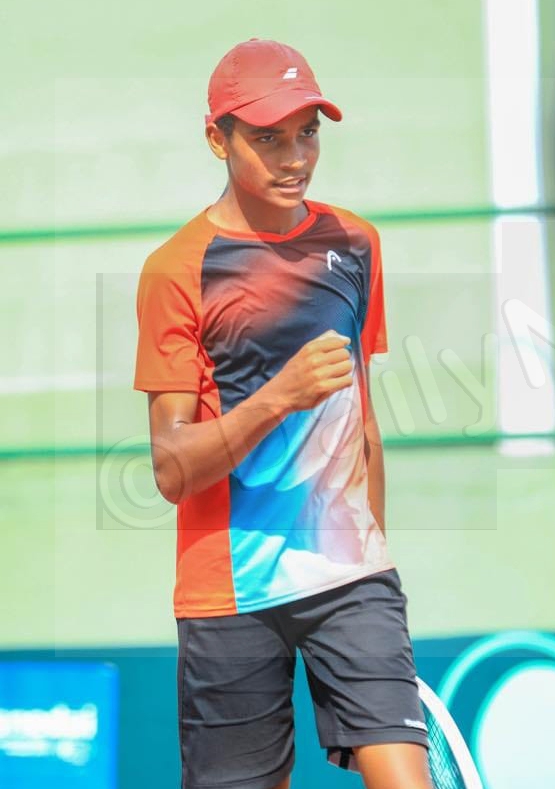
BTA Expresses Delight at Raguin’s Incredible Run
Botswana Tennis Association (BTA) vice president Nonofo Othusitse has expressed the association’s delight at Ntungamili Raguin’s historic achievement at the Australian Open Junior Championships 2026.
“This is a performance exceeding all expectations. We are in awe of Ntungamili’s incredible displays at his maiden Grand Slam,” Othusitse said of Raguin’s fairytale run.
“With this performance, his life has completely changed, and he has shone a light not only on Botswana but on Africa as a whole.”
Raguin, who is number 75 in the junior rankings, will be looking to proceed to the quarterfinals when he takes on Luis Guto Miguel of Brazil in a last 16 encounter tomorrow.
The young ace booked his place in the last 16 after a hard-fought 6-2, 3-6, 6-4 victory over 15th seed Gavin Goode of the United States at Melbourne Park on Tuesday morning.
In his debut tournament at the Junior Grand Slam, Raguin won the opening set in emphatic fashion, sending a clear message that rankings counted for little on the court.
The 17-year-old slowed down slightly in the second set, allowing Goode to level the match with a convincing win.
However, the third and decisive set turned into a tense battle of nerves and endurance, with Raguin demonstrating remarkable mental strength to clinch it 6–4 and seal a memorable victory.
Tuesday’s win marked Raguin’s second at the tournament. In the opening round played on Sunday, he defeated Dimitar Kisimov of Bulgaria 7-5, 1-6, 6-4 in another three-set encounter.
The performance highlighted the work of his technical team, led by coach Killian Sinclair, whose preparations ensured the teenager was ready for both tactical challenges and physical endurance.
Raguin’s victory over Goode marked his fourth win against a top-30 opponent in the past two weeks, a statistic that has thrilled tennis followers.
-

Government Sets Aside P97M for FMD Interventions
Government has approved the Foot and Mouth Disease (FMD) response plan for immediate implementation with P97 million allocated for urgent interventions.
This was revealed by acting Minister of Lands and Agriculture, Mr David Tshere on Tuesday when addressing the public on government’s FMD preparedness control.
Also, the minister announced an initiative toward a shared financial responsibility model, with the Business Botswana having pledged P1 million already.
The National Development Bank has been appointed to administer funds contributed by the private sector development partners and members of the public.
As the FMD outbreaks in South Africa and Zimbabwe continued to pose a risk of incursion into Botswana, Mr Tshere noted that Botswana’s intention was to ensure that FMD was controlled at a regional level, adding that the transition moved away from a government-driven model to one that actively involved communities, farmers and the private sector.
As such, he called on Batswana to partner with government in controlling the disease including providing financial support amid prevailing fiscal constraints.
As part of mitigation efforts, he said government had established a Foot and Mouth Disease Command Centre, chaired by the Office of the President to coordinate inter-ministerial responses.
The centre operates a call centre with both a toll-free line and a WhatsApp contact, he said.
Furthermore, he said community participation would be central to disease prevention and control efforts, including regulating livestock movement through kraaling and herding animals away from high-risk areas.
Mr Tshere said response teams had been deployed along border areas to restrict the movement of cattle from South Africa and Zimbabwe into Botswana.
“Movement restrictions have been imposed in border villages in Ramotswa, Borolong, Kgatleng, Bobirwa, Tutume and the North East District. Disease surveillance has been intensified in these areas, with livestock movement permitted only for animals destined for slaughter and subject to authorised movement permits,” he said.In a move to reduce the risk of FMD transmission, he said the holding period for stray cattle had been reduced from three months to 14 days, adding that unclaimed stray cattle would be slaughtered at the Botswana Meat Commission abattoir, with proceeds directed towards FMD control measures.
Mr Tshere said government continued to enforce strict veterinary protocols for livestock that strayed into neighbouring FMD-affected zones.
As of January, he said 48 cattle had been destroyed after crossing into South Africa and Zimbabwe.
Mr Tshere highlighted that compensation of P700 would be paid to cattle owners and P200 for goats if animals cross into red zones or show signs of FMD.
The exercise, he said, was being carried out in collaboration with the Ministry of Lands and Agriculture, cattle producers and non-cattle producers.
Mr Tshere emphasised that FMD posed a severe threat to agriculture due to its high contagiousness and environmental resilience.
He also encouraged dikgosi to use mophato systems to help control the spread of FMD, citing Bobirwa as an area where the approach had yielded positive results.
A dedicated communication team has also been established to disseminate information, while sensitisation through kgotla meetings has already been conducted in villages including Ramotswa, Borolong, Mochudi and Tutume Districts. -

Letsholathebe Records Improved Medical Supplies
Letsholathebe Memorial Hospital in Maun is showing signs of recovery as availability of medicines including essential ones and other medical supplies has improved from 15 per cent to 30 per cent, with another consignment expected before the end of this week.
This was revealed by the hospital superintendent, Dr Lebogang Mokotedi during Minister for State President, Defence and Security, Mr Moeti Mohwasa’s tour of the hospital on Tuesday.
“Drugs availability and other medical commodities have gradually improved this year as compared to last year and we are expecting more orders before the end of the month.Despite the shortage, we have been trying our level best to offer quality services with the little we had,” revealed Dr Mokotedi.
It was reported in December that the hospital was experiencing shortage of drugs and non-drug commodities and that inconsistent supplies of the required commodities affected patient management, especially those requiring to be assisted on emergency basis.
By then, vital drugs were reported to be at 75.5 per cent, essential drugs at 63.9 while necessary drugs remained at 52.1 per cent with an order fill rate of 21 per cent from the Central Medical Stores.
She also apprised the minister that they had ensured the security of medicines in the facility as all medication storage was restricted to only authorised personnel.
To further strengthen security, she stated that their intention was to install alarms and CCTV cameras in drug storage areas.
Regarding feeding of patients, she said it also remained a serious challenge due to financial constraints citing that they operated under a tight budget where allocation of funds for food services was limited.
Another challenge was shortage of ambulances as only six out of 18 were functional, saying the shortage affected the flow of referrals to both Francistown and Gaborone.
Dr Mokotedi also reported a shortage of medical specialists, among them a surgeon, a gynaecologist and a physician, explaining that currently they were operating with one gynaecologist, whose services patients waited 24 to 26 months to access.
Despite the challenges, she shared some of their achievements citing that facility recently underwent refurbishment for both the Intensive Care Unit (ICU) and the theatre to improve service delivery.
The ICU, which was officially opened last year August had not been fully operational due to structural anomalies and equipment issues.
Currently, the hospital management has procured equipment and awaiting staff and its functionality was hailed as a major milestone for the hospital, enhancing critical care capabilities for Maun and surrounding districts.
“The introduction of this unit is a significant upgrade to the hospital’s capacity to handle critically ill-patients locally. We now need a doctor who will man the unit,” Dr Mokotedi said.
In addition, she informed the minister that a new haemodialysis unit was also introduced, which was being operated on a public-private partnership basis.
For a long time, patients had to travel long distances to as far as Francistown to access kidney health services and Dr Mokotedi praised government efforts to bring quality health services including highly specialised ones.
For his part, Minister Mohwasa praised employees of the hospital for their resilience and high level of commitment in delivering quality services despite working under difficult conditions.
He appreciated that staff had demonstrated resilience and a strong sense of moral duty to maintain quality patient care in the face of several challenges, which include drug shortages.
Mr Mohwasa assured the hospital management that the Ministry of Health was working around the clock to address the challenges at hand so as to improve service delivery.
He said the ministry was working hard to address the issue of shortage of medicines by ensuring that they reached every hospital and clinic across the country on time.
Mr Mohwasa admitted that there was shortage of drugs, which he partly blamed on corruption by suppliers and an inefficient procurement system.
He emphasised that government was however working tirelessly to improve the efficiency of the medicine supply chain.
The minister and his entourage toured some sections of the hospital including the pharmacy, some laboratories, and specialised units to appreciate challenges.
He also visited the outpatient department where he interacted with patients queuing for services. -
Kedikilwe Highlights Necessity to Prioritise Needs
Member of Parliament for Serowe West, Mr Onalepelo Kedikilwe has implored constituents to assess the country’s competing needs in order to make informed decision during a looming Constitutional Court referendum.
Speaking during a kgotla meeting in Marulamantsi ward in Serowe on Tuesday, Mr Kedikilwe said it would be amiss for him to influence constituents to vote against or in favour of the establishment of the ConCourt.
Therefore, he said assessment of the country’s competing needs would inform constituents to make an appropriate decision. when casting a ballot during a referendum, pointing that it was every individual’s right to universal suffrage.
Furthermore, he said universal suffrage guarantees voting rights to all adult citizens, regardless of gender, race or socio-economic status, thus he noted influencing them would be an infringement of the said rights.
He said their ‘yes or no’ for the establishment of ConCourt was dependent on assessment of competing needs, hence the need to prioritise pressing issues. Mr Kedikilwe said it was paramount to consider prioritising pressing issues such as health and education sectors were bedevilled with challenges and needed urgent attention.
For his part, Headman of arbitration Kgosi Onkemetse Magola of Marulamantsi concurred that there was a lot of competing needs in the area that needed urgent attention.
He said Marulamantsi ward that fell under the catchment area of Mannathoko Primary School in Serowe was too far from the school for pupils more especially beginners and therefore expressed the wish to have standard one to three classes established in the area.
Also, Kgosi Magola decried that over 50 children in Marulamantsi were not schooling and have become street children. He underscored that his area of jurisdiction was facing economic challenges and should be given similar treatment as other abodes of Basarwa people descent such as Malatswae, Mmashoro and Dimajwe.
To this end, he said such categorisation would accord Marualamantsi residents an opportunity to substantially benefit from special dispensation programmes.
However, constituents were of the view that pressing issues needed urgent attention and therefore should precede ConCourt. They emphasised that they were not against the idea to establish the ConCourt but hinted its timing was off.
Residents requested for a clinic in the area, arguing that there was too much congestion in other health facilities where they accessed services. Constructing a clinic in Marulamantsi would also spare residents time and distance they to endured in search of medical services, they said adding that a plot for the facility was readily available at Sebabi ward.
On other issues, a resident Ms Barulaganyi Kgaogano decried some irregularities in awarding tenders for bread supply in schools. She also complained about delay in payments after supplying bread, which she noted, did not argur well with business.
Ms Kgaogano is of the view that renumerations for people engaged either on attachment or internship basis at various government ministries should be commensurate with their qualifications because ‘they performed similar tasks as their permanent and pensionable counterparts’.
-
School Feeding More Than a Meal
School feeding is a powerful, multi-sector investment that strengthens education systems, improves child wellbeing and support local economies.
This was said by African Union Senior Education Policy Officer, Dr Caseley Stephens, during the 11th African Diaspora Scientific Federation breakfast meeting in Gaborone recently.
He explained that well-designed school feeding programmes improved health and welfare outcomes, reinforced social protection systems and built community resilience, while increased school attendance and retention.
“It connects nutrition, health and education in one powerful strategy. It contributes directly to human capital formation and long-term economic productivity,” Dr Stephens added.
He further highlighted that school feeding aligned with the African Union Agenda 2063, particularly Aspiration One, which envisioned a prosperous, inclusive and sustainable Africa driven by its people.
He further said the holistic impact of school feeding was precisely why its relevance continued to grow across AU member states.
Deputy Permanent Secretary in the Ministry of Child Welfare and Basic Education, Mr Steve Botlhasitse said school feeding programmes were central to Africa’s development agenda.
Mr Bothasitse stressed that access to meals was a key retention tool, warning that learners were more likely to miss school when food was unavailable.
“If learners are not given meals in our schools, they will somehow miss school,” he said.
As such, he urged stakeholders, including the Ministry of Local Government and Traditional Affairs and the tourism sector to adopt a proactive approach to sustaining school feeding programmes.
“We must plan ahead and find solutions to ensure that meals are nutritious, safe and accompanied by clean water and good hygiene practices is essential,” he said.
Extending an invitation to the business community, Mr Bothasitse said partnerships could help strengthen systems, scale effective practices and build resilience so that every school, in every community, could reliably provide safe and nutritious meals.
“Your backing in school feeding programmes is an investment in Africa’s future workforce and communities,” he said.
Also addressing the meeting was Acting Deputy Permanent Secretary, Ms Veronica Mochotlhi, who traced the evolution of Africa’s school feeding agenda, noting that it gained momentum following a 2016 study visit to Brazil focused on home-grown school feeding models.
She said the initiative linked local farmers to school feeding programmes, boosting nutrition, education and local economies. Ms Mochotlhi said following that engagement, African heads of state resolved to establish the Africa Day of School Feeding, which debuted in Niger as an annual event.
She noted that the 2025 Africa Day of School Feeding was commemorated in the Central African Republic under the theme: A Decade of Nourishment: Celebrating the Past, Securing a Just Future.
Looking ahead to 2026, she said the focus would be on inspiring action, sharing knowledge, identifying barriers and co-creating solutions to strengthen school meal policies, governance and financing.
She added that each year should highlight progress, discuss challenges and mobilise support to scale up these programmes so that they reached every child in Africa.
Meanwhile, Botswana is set to host the 11th African Diaspora Scientific Federation commemoration on February 28.